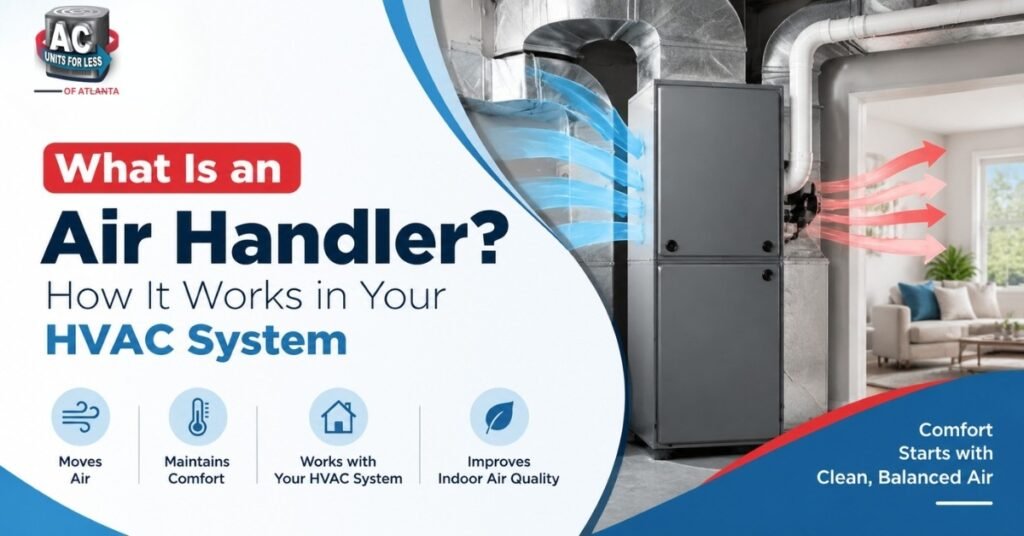
If you’ve ever poked around a mechanical closet or stuck your head into an attic and found a big metal box wired into a maze of ducts, that box was almost certainly an air handler. Homeowners ask what is an air handler more often than you’d expect, mostly because the unit hides in plain sight while the outdoor condenser gets all the credit. Plenty of people also wonder what is the air handler compared to the whole outdoor unit sitting on the concrete pad outside, assuming they’re basically the same thing. In plain terms, an air handler is the indoor half of the system, the part that actually moves conditioned air through your home’s duct-work and into the rooms where you live.
What Is an Air Handler? A Quick Definition
So what is an air handler, stripped down to basics? It’s the indoor cabinet that pulls room air in, pushes it across a coil, and sends it back out through the supply ducts. Understanding what is the air handling unit matters because it flips the usual assumption: the outdoor unit gets the visual attention, sitting there on its concrete pad, but the indoor cabinet is doing the actual work of circulating air through every room on the system. Once you know what is an air handler and where it sits in the bigger HVAC picture, a lot of comfort complaints start making a lot more sense.
For homeowners and property managers browsing options, a good starting point is looking at HVAC Equipment Sales in Dacula, where you can compare units side by side before deciding what actually fits your space.
How an Air Handler Works
An air handler is a metal cabinet packed with a blower fan, an evaporator coil, an air filter, and, on many models, an electric heating element for backup warmth. Room air gets pulled in through the return ducts, crosses the coil where the heat transfer happens, and gets pushed back out through the supply ducts by the blower. Nothing about that cycle is complicated on paper, but the execution matters a lot more than people assume. The blower motor does most of the physical work in this whole assembly, and it has to move a specific volume of air through every duct run without creating rattling noise or pressure imbalances that leave one room hot and another freezing. Older single-speed blowers just run at full tilt or not at all. Newer variable-speed motors ramp up and down based on real-time demand, which tends to feel smoother and, in a lot of cases, cuts down on the short bursts of noise that single-speed systems are known for. The trade off is usually cost up front, and whether that trade off is worth it depends a lot on how sensitive you are to airflow noise in the first place.
What Does an Air Handling Unit Do?
So what does an air handling unit do, beyond the obvious job of moving air around? A handful of things happen at once inside that cabinet:
- Circulates conditioned air from the coil through the duct-work and into living spaces
- Pulls return air back into the system so it can be reconditioned instead of wasted
- Filters dust, pollen, pet dander, and other particles as air passes through
- Supports humidity control by letting moisture condense on the coil during cooling cycles
- Distributes heat evenly when paired with a heat pump or a supplemental heat strip
Each of those jobs leans on the others. A clogged filter drags airflow down, which means less air crosses the coil, which means weaker heat transfer, which means the system runs longer to hit the same set-point. It’s a chain reaction, and it usually starts with something as small as a filter nobody remembered to swap.
Where Is the Air Handler Located?
People frequently ask where is the air handler located, and honestly, the answer depends entirely on how the house was built. In a lot of single-story homes, it sits in a closet near the bedrooms, in the garage, or in a small mechanical room off the hallway. Two-story homes often run a second unit in the attic to handle the upper floor on its own zone, separate from whatever’s conditioning the ground level. Climate shapes this too: builders in warmer parts of the country lean on attics and garages since freezing pipes aren’t really a worry, while colder-climate builders tend to tuck the unit into a conditioned basement or a insulated utility closet so it isn’t fighting extreme temperature swings on top of everything else. Property managers running larger buildings, especially hospitality properties, deal with a more complicated version of this question. Instead of one air handler serving one home, you might have a dozen or more spread across different floors and zones, each with its own return path and its own version of that same question. That kind of setup calls for a broader strategy around Hotel Air Conditioning, since guest comfort tends to be less forgiving than residential comfort. Nobody complains politely about a stuffy hotel room.
Air Handler vs. Furnace: What’s the Difference?
It’s an easy mix-up. Both sit indoors, both connect to the same ductwork, and both look roughly like a metal box from the outside. But a furnace burns fuel, usually natural gas, or uses electric resistance to generate heat on its own. An air handler doesn’t generate anything by itself in most residential split systems; it relies on a coil connected to an outdoor heat pump or condenser to actually condition the air. Some air handlers include a backup electric heat strip for unusually cold stretches, but that strip is a supplement, not the main event. It’s not built to carry the same heating load a furnace handles day in and day out.
This distinction matters a lot when comparing Air Conditioning and Heating Systems for a home or a commercial building, and it’s exactly the point where people start asking what is the air handling unit versus the furnace sitting right next to it in the same mechanical closet.
What Is a Air Handling Unit Made Of?
Breaking down what is a air handling unit made of helps explain why the whole thing needs a bit of ongoing attention. Here’s the short version, part by part:
| Component | Function |
| Blower motor | Moves air through the ductwork at a set or variable speed |
| Evaporator coil | Absorbs heat from indoor air during cooling cycles |
| Air filter | Traps dust and particles before air recirculates |
| Housing cabinet | Contains and protects internal components |
| Electric heat strip (optional) | Provides supplemental warmth when paired with a heat pump |
Knowing what is the air handler made of helps when you’re describing a problem to a technician over the phone; naming the specific part shortens the conversation considerably. And honestly, it’s the same background knowledge behind what is a air handling unit for anyone comparing systems for the first time, whether that’s a homeowner or someone specifying equipment for a small commercial build-out.
Filters, Airflow, and Why Sizing Actually Matters
One thing that trips up a lot of people: bigger isn’t automatically better. An air handler that’s over sized for the duct work it’s tied to will short-cycle, meaning it reaches the set point fast, shuts off, then kicks back on again a few minutes later without ever really dehumidifying the space. That constant on-off pattern is rough on components and doesn’t do much for comfort either. An undersized unit has the opposite problem. It runs almost constantly, struggling to keep up on the hottest or coldest days, and the duct work ends up feeling like a bottleneck no matter how hard the blower works.
Filter choice plays into this more than people realize. A high-MERV filter traps finer particles, which sounds great until you consider that a filter rated too dense for a given blower can choke airflow and force the motor to work harder than it was designed to. Matching filter rating to blower capacity is one of those details that rarely gets discussed until something feels off.
Noise, Efficiency, and What Actually Affects Your Energy Use
Air handlers get blamed for a lot of noise complaints that aren’t really their fault. A rattling sound usually traces back to a loose panel screw or a duct connection that’s come slightly apart, not the blower motor itself. That said, blower speed does affect how much you notice the system running. A single-speed unit moving max airflow on a hot afternoon is going to be audible in an adjacent room, while a variable-speed unit easing into a lower gear during mild weather tends to fade into the background.
Energy use follows a similar pattern to comfort. A well-matched air handler and outdoor unit, running on ductwork that’s actually sized for the home, uses less energy over a season than a mismatched pair fighting each other the whole time. This is part of why sizing keeps coming up throughout this whole topic: it isn’t just about comfort on the hottest day of the year, it’s about how hard the system has to work on every ordinary day in between. A slightly undersized outdoor unit paired with an oversized air handler, for instance, can leave a home feeling cool but sticky, since the air moves through fast enough to lower the temperature without spending enough time on the coil to pull real moisture out of the air.
Ductwork condition matters just as much as equipment selection. Leaky or poorly insulated ducts running through an unconditioned attic can lose a meaningful share of conditioned air before it ever reaches a room, which means the air handler ends up compensating for losses that have nothing to do with the equipment itself. Sealing and insulating ductwork is often the cheaper, higher-impact fix compared to upgrading the air handler on its own.
Common Signs Your Air Handler Needs Attention
A handful of patterns tend to show up when an air handler is struggling to keep pace with demand:
- Uneven temperatures between rooms connected to the same duct run
- Weak airflow coming from supply vents, even with the system running
- A musty smell suggesting moisture buildup around the coil or drain pan
- Short cycling, where the system turns on and off more often than it should
- Rising humidity indoors even while the system is actively cooling
None of these signs are dramatic on their own. That’s kind of the problem. They creep in slowly enough that a lot of people adjust around them instead of noticing the underlying cause, especially during the shoulder seasons when the system isn’t running as hard.
Catching these signs early makes a real difference in how comfortable a home feels day to day, particularly through peak summer stretches when the whole system is under the most strain and has the least room for error.
Homeowners weighing their options often want a clearer picture of Air Conditioning Systems as a whole before deciding whether their current setup still matches what the home actually needs now, versus what it needed when the system was originally sized.
Frequently Asked Questions
Q1: What is an air handler in one sentence?
It’s the indoor unit that moves conditioned air through a home’s ductwork using a blower, coil, and filter working together.
Q2: What is the air handling unit compared to a full HVAC system?
The air handling unit is one piece of a full HVAC system; it works alongside an outdoor condenser or heat pump to actually condition the air before circulating it through the home.
Q3: What is the air handler’s average lifespan?
Most air handlers last somewhere between 15 and 20 years when the filter gets changed on schedule and airflow stays consistent, though usage patterns and local climate both shift that number quite a bit.
Conclusion
An air handler isn’t the flashiest piece of an HVAC system, and it rarely gets mentioned unless something feels off, but it’s doing quiet, constant work every time the system runs. Now that you know what is an air handler, how it moves air through the house, and what does an air handling unit do behind that cabinet door, you’re in a better spot to talk through comfort issues with a technician instead of guessing at what’s wrong. And the next time someone asks where is the air handler located in your own home, you’ll already know exactly where to point them.