
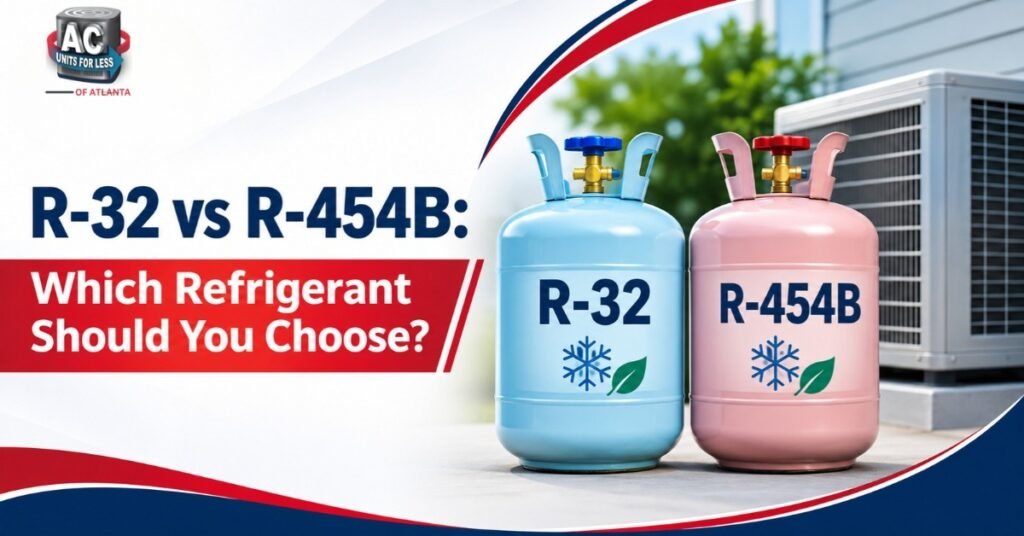
Shopping for a new air conditioner or heat pump in 2026 means picking a refrigerant, whether you planned to or not. Since January 2025, new residential systems sold in the US have moved to A2L refrigerants, and almost every model on the market now runs on one of two options. The r-32 vs r-454b question gets a lot of hype online, but it does shape efficiency, servicing, and long-term support, so it is worth understanding before you buy.
Here is the short answer. R-32 gives slightly better efficiency and cooling capacity, while R-454B has a lower global warming potential and runs at pressures close to the old R-410A. In most cases your brand makes the call for you. Daikin and Goodman build around R-32, so if you are browsing a Goodman R32 air conditioner, you have already picked a side. Carrier, Trane, Lennox, Rheem and Mitsubishi went with R-454B.
What Are R-32 and R-454B?
Both are A2L refrigerants, which means low toxicity and mild flammability. R-32 (difluoromethane) is a single-component refrigerant. R-454B is a blend of roughly 68.9% R-32 and 31.1% R-1234yf, an HFO with very low climate impact. Knowing the r32 vs r454b refrigerant makeup explains most of their differences. In a way, the r-32 vs r-454b debate compares R-32 on its own against R-32 mixed with a lower-GWP ingredient.
Why the Industry Moved Away From R-410A
The EPA Technology Transitions rule under the AIM Act caps GWP at 700 for new residential AC and heat pump systems. R-410A sits around 2,088. R-32 (675) and R-454B (about 466) both clear that bar comfortably. Existing R-410A systems keep running and can still be serviced. Neither new refrigerant can go into an older R-410A unit, though, because pressures and components are different.
R-32 and R-454B Side by Side
| Factor | R-32 | R-454B |
| Type | Single-component HFC | Blend (R-32 + R-1234yf) |
| GWP (AR4) | 675 | About 466 |
| Ozone depletion potential | 0 | 0 |
| ASHRAE safety class | A2L | A2L |
| Temperature glide | None | About 1.2K |
| Operating pressure | Higher than R-410A | Close to R-410A |
| Refrigerant charge needed | Lower | Higher |
| Efficiency and capacity | Slightly higher | Slightly lower |
| Common brands | Daikin, Goodman | Carrier, Trane, Lennox, Rheem, Mitsubishi |
R32 vs R454B Efficiency: What the Numbers Show
R-32 has better thermodynamic properties. It moves heat well and delivers more cooling capacity per unit of compressor displacement. Daikin research puts R-32 systems up to 10% more efficient than R-410A equivalents, while R-454B shows a smaller gain. On paper, R-32 wins.
On real equipment, though, r32 vs r454b efficiency gaps shrink fast. Manufacturers tune compressors, coils and inverters around their chosen refrigerant, so the SEER2 and HSPF2 ratings tell you far more than the gas inside. A well-built 17 SEER2 R-454B system will beat a basic 14.3 SEER2 R-32 unit every single time. In hot, humid states where AC runs for months, that rating drives your monthly bills, which is why these smart HVAC choices for Georgia homes focus on efficiency first.
Where R-454B Pulls Ahead
- Lower GWP (466 vs 675), roughly 31% less direct climate impact
- Pressures similar to R-410A, so technicians adapted to it quickly
- More headroom if GWP limits tighten again in the future
Where R-32 Pulls Ahead
- Single component with no glide, so a leak does not change its composition
- Smaller charge for the same capacity
- Used in hundreds of millions of systems worldwide since 2012
- Slightly better efficiency and cooling capacity
Is One Safer Than the Other?
No. Safety is one area where the r-32 vs r-454b comparison is a tie. Both carry the same A2L rating. They are hard to ignite and burn slowly, and new systems include leak detection sensors and mitigation controls under UL 60335-2-40. What matters is that whoever handles your system is trained and equipped for A2L refrigerants.
R32 vs R454B Which Is Better for Your Home?
There is no universal winner in r-32 vs r-454b. Choose the system, not the gas. Look at SEER2, HSPF2, sizing, warranty and local service support first, then let the refrigerant follow.
Go with R-32 if you like Daikin or Goodman equipment, want strong cooling capacity, or prefer a refrigerant with a long global track record. Single-stage and variable-speed options are easy to find, and these R32 heat pump condensers cover sizes from 1.5 to 5 tons.
Go with R-454B if the lowest possible GWP matters to you, or if your preferred brand is Carrier, Trane, Lennox, Rheem or Mitsubishi. The r32 vs r454b which is better debate rarely needs to go further than that.
Is R32 Better Than R454B in Hot Climates?
Slightly, on paper. In long cooling seasons, R-32’s capacity edge helps a little. But is r32 better than r454b enough to choose a weaker system for it? No. Proper sizing, duct condition and the SEER2 rating will affect comfort and bills far more than the refrigerant.
What About Service and Parts?
Both need A2L-rated recovery machines and tools. R-32 is easier to recover and reuse because it is a single component. R-454B has a small glide, so technicians charge it as a liquid. The two can never be mixed, and you cannot swap one into a system built for the other.
Whichever way your r-32 vs r-454b decision goes, buy from a dealer that carries both. If ductless or multi-zone comfort is the goal, the Mitsubishi outdoor units lineup includes R-454B multi-zone heat pump models built for year-round use.
Conclusion
The r-32 vs r-454b choice is less dramatic than it looks. R-32 brings a small efficiency and capacity edge, and R-454B brings a lower GWP and familiar pressures. Pick the brand, efficiency rating and size that fit your home, and the r-32 vs r-454b question mostly answers itself.
Frequently Asked Questions
Q1: Which is more efficient, R-32 or R-454B?
R-32 is slightly more efficient in lab testing. On actual equipment, the SEER2 rating matters more than the refrigerant.
Q2: R32 vs R454B which is better for the environment?
R-454B. Its GWP of about 466 is roughly 31% lower than R-32’s 675, though both meet the EPA 700 limit.
Q3: Is R32 better than R454B for cooling performance?
Yes, by a small margin. R-32 offers higher cooling capacity, but system design decides the real result.
Q4: Will the r32 vs r454b refrigerant choice matter in ten years?
Probably not much. Both sit under current EPA limits and are used by major manufacturers, so supply should stay steady.
Q5: Can I put R-454B or R-32 in my R-410A system?
No. Neither is a drop-in option. They need equipment designed for A2L refrigerants.