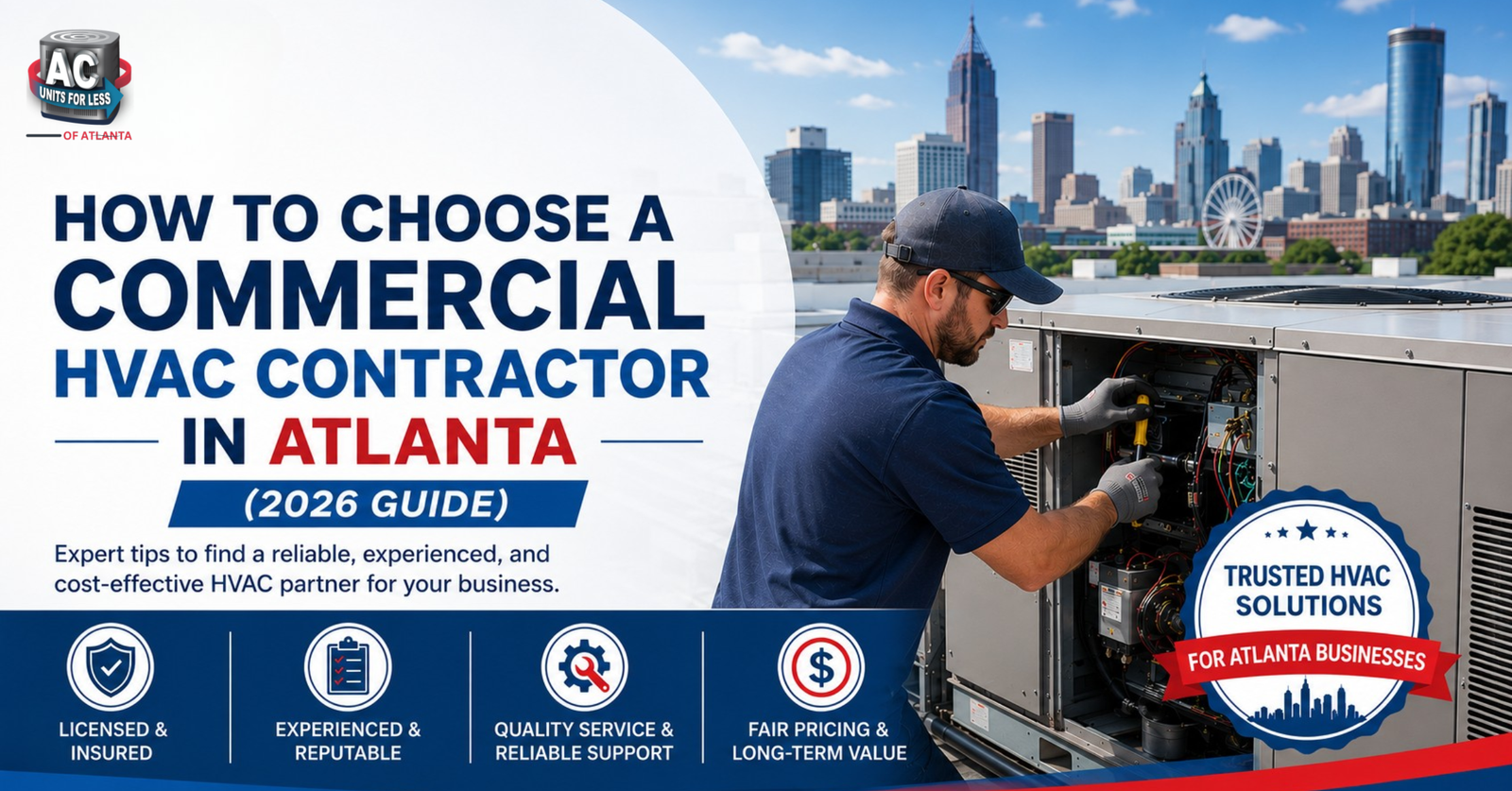
Atlanta’s climate is no joke. Summers push past 95°F for weeks at a time, and the humidity makes it feel worse. For any commercial property — an office building, retail space, restaurant, or apartment complex — a failing HVAC system is not just uncomfortable. It’s a liability. That’s why finding the right commercial HVAC contractor matters more than most property owners realize.
This guide breaks down exactly what to look for, what questions to ask, and how to avoid the contractors who will waste your time and money.
What Does a Commercial HVAC Contractor Actually Do?
A commercial HVAC contractor is responsible for installing, maintaining, and repairing heating and cooling systems in non-residential buildings. That’s not the same as residential HVAC work. Commercial systems are larger, more complicated and often serve more than one zone across larger square footage.
Heating and air conditioning contractors who specialize in commercial work understand load calculations for large spaces, rooftop unit installations, ventilation compliance under local building codes, and multi-zone control systems. Not every HVAC technician has this background — and it shows when something goes wrong.
Common commercial services include:
· New installation of packaged rooftop units, split systems, and VRF systems
· Preventive maintenance programs and seasonal tune-ups
Commercial vs. Residential HVAC: Why the Difference Matters
Most HVAC contractors in my area advertise both residential and commercial services. That’s fine, but it’s worth digging into their commercial experience specifically. A technician who primarily works on single-family homes will be out of their depth on a 10,000 sq ft retail space.
Commercial systems run longer hours, handle more people, and face stricter ventilation requirements under ASHRAE standards. Commercial HVAC contracts also tend to involve more documentation — equipment specs, maintenance logs, warranty records — which a serious contractor will have systems in place to manage.
What to Check Before Hiring: A Practical Checklist
Use this table when evaluating any commercial HVAC contractor in Atlanta:
| Factor | What to Look For | Why It Matters |
| License & Insurance | State-licensed, general liability + workers’ comp | Non-negotiable |
| Commercial Experience | 5+ years in commercial HVAC work | Ask for project references |
| Brand Familiarity | Goodman, Daikin, MrCool, or Trane certified | Affects parts sourcing speed |
| Service Contracts | Offers preventive maintenance plans | Reduces emergency costs |
| Response Time | Same-day or next-day for urgent issues | Critical for commercial tenants |
| Pricing Transparency | Itemized quotes before work begins | No surprise invoices |
Questions to Ask Before You Sign
1. Are you licensed and insured in Georgia?
This is the first question, full stop. Georgia requires HVAC contractors to hold a state license. Ask for the license number and verify it at the Georgia Secretary of State’s website. Any hvac contractor commercial operator who hesitates on this question is a red flag.
2. Do you have experience with systems like mine?
Packaged rooftop units, chilled water systems, and VRF systems each require different expertise. Describe your building and ask whether they’ve worked on similar setups. Request two or three commercial references from Atlanta-area projects.
3. What brands do you work with?
If your building already has Goodman, Daikin, or MrCool equipment, you want a contractor who knows those systems. AC Units For Less Atlanta supplies wholesale commercial HVAC equipment from these exact brands to contractors throughout the Atlanta metro area. Working with a supplier your contractor already knows speeds up parts availability when something breaks.
4. What does your commercial HVAC service contract include?
A solid service contract includes planned maintenance visits, priority response to emergencies and documentation for each service call. Preventative maintenance is often less expensive than emergency repairs, especially when Atlanta summers are at their hottest.
5. How do you handle permits and inspections?
Commercial HVAC work in Atlanta typically requires permits through the City of Atlanta’s Office of Buildings or the relevant county office. A reputable hvac contractor atlanta specialist will pull permits as part of the job — not ask you to handle it.
Red Flags to Watch For
A few warning signs that a commercial HVAC contractor is not the right fit:
· No written quote — verbal estimates only
· Can’t provide proof of insurance on the spot
Also be cautious of contractors who push specific equipment without asking about your building first. Sizing matters. An undersized system will run constantly and fail early. Oversized systems short-cycle and leave humidity problems behind.
Serving Atlanta and Surrounding Areas
AC Units For Less Atlanta works with independent contractors and property owners across the Atlanta metro, including Alpharetta,Comer, and surrounding areas. If you’re looking foranswers to common HVAC equipment questions, our team is available Monday through Saturday, 9am to 6pm.
We supply wholesale Goodman, Daikin, and MrCool equipment at prices that give hvac contractors in my area a real margin advantage. Small contractors shouldn’t have to pay big-distributor prices to get quality equipment.
For context on how these systems perform in Georgia’s climate, this resource is worth reading:
Reliable Heating and Cooling Systems for Flowery Branch Properties
FAQ: Commercial HVAC Contractors in Atlanta
What is the difference between a commercial and residential HVAC contractor?
Commercial HVAC contractors work on larger, more complex systems built for multi-zone spaces, higher occupancy loads, and extended operating hours. Residential contractors typically work on single-zone split systems for homes. The licensing requirements, equipment knowledge, and scope of work differ significantly.
How much does a commercial HVAC contractor charge in Atlanta?
Costs vary widely depending on system type, building size, and scope of work. A new rooftop unit installation might run $8,000 to $30,000+ depending on tonnage. Maintenance contracts for a mid-size commercial building typically range from $1,500 to $5,000 annually. Always get at least three itemized quotes before committing.
Do I need commercial HVAC contracts for a small office?
Yes. Even small commercial spaces benefit from a maintenance agreement. Heating and air conditioning contractors who handle your maintenance regularly will catch problems before they become expensive failures — and during a Georgia summer, that matters a lot.
How do I find HVAC contractors in my area that specialize in commercial work?
Ask for references from other commercial property owners, check Georgia contractor licensing records, and look for contractors who work with major equipment brands. AC Units For Less Atlanta can connect you with contractors in the metro area who have a track record of commercial work.
Bottom Line
Choosing the right commercial HVAC contractor in Atlanta comes down to license verification, commercial experience, brand knowledge, and transparent pricing. Don’t rush the decision — the contractor you pick will be responsible for keeping your building operational through Atlanta’s brutal summer heat.
If you’re a contractor looking for wholesale HVAC equipment, or a property owner trying to understand your options, reach out to AC Units For Less Atlanta at (470) 857-4555 or visit us at 1005 Mansell Rd, Roswell, GA 30076.