
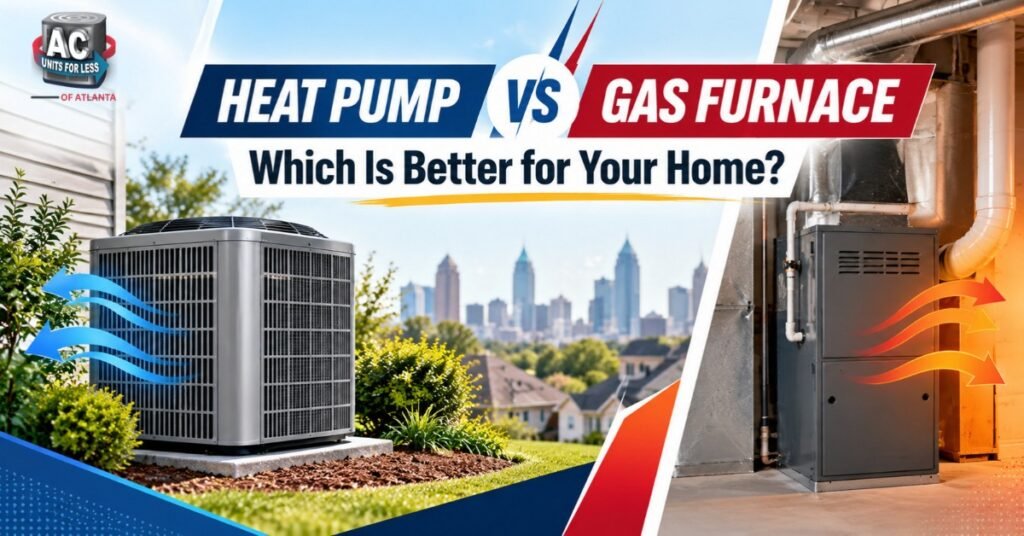
Every fall, the same question lands in our inbox from homeowners around Atlanta. The old heater is tired, the bills keep creeping up, and they want to know which way to go. The heat pump vs gas furnace debate sounds technical, but the answer usually comes down to a few plain facts about your house.
Both systems keep you warm. They just do it in very different ways, and that changes your monthly bills, your comfort on cold mornings, and how long the equipment lasts. I’ll walk through the heat pump vs gas furnace question honestly, including the parts sales brochures tend to skip.
If you already know you want new equipment and just need the right model, our team handles HVAC Equipment Sales in Alpharetta and nearby cities. Read this first, though. Picking the wrong system type is a bigger mistake than picking the wrong brand.
● A heat pump moves heat, while a gas furnace makes heat by burning fuel.
● Heat pumps also cool your home in summer, so one unit covers both seasons.
● Gas furnaces push out hotter air and hold up better in deep cold.
● Your local winter, fuel rates, and existing ductwork usually decide the winner.
What Is the Heat Pump vs Gas Furnace Difference?
The core heat pump vs gas furnace difference is simple. A furnace creates heat by burning natural gas or propane. A heat pump creates almost no heat at all. It pulls warmth out of the outdoor air and carries it inside, the same way your fridge pulls heat out of the food compartment.
That one distinction drives everything else. Because a heat pump only moves heat, it can deliver more energy than it consumes. A furnace can never beat 100% efficiency, because you can’t get more heat out of gas than the gas contains. Physics sets that ceiling, and no clever engineering gets around it. Keep that in mind when a spec sheet looks too good.
- Fuel source: electricity for a heat pump, natural gas or propane for a furnace.
- Cooling: a heat pump cools and heats, while a furnace needs a separate AC.
- Air temperature: in the vent, the furnace air is hot, often 120°F to 140°F.
- Venting: furnaces have to have a flue to vent exhaust gasses, heat pumps don’t burn anything.
How a Heat Pump Works
A heat pump uses refrigerant, a compressor, and two coils. In winter, the outdoor coil absorbs heat from the air, even at 30°F, and the compressor squeezes that refrigerant until it gets hot. Indoors, a fan blows air across the warm coil and sends it through your ducts.
In summer, a reversing valve flips the process and the same unit acts like a central air conditioner. That two in one design is the main reason buyers in Georgia lean toward heat pumps. If you want a reliable mid range option, our guide to the Goodman Heat Pump breaks down the models worth a look.
How a Gas Furnace Works
A gas furnace burns fuel inside a sealed combustion chamber. The flame heats a metal heat exchanger, and the blower pushes household air over that hot metal. Exhaust gases leave through a flue pipe, so the combustion never mixes with the air your family breathes.
The result is fast, strong heat. Turn the thermostat up on a 25°F morning and a furnace will have the house cozy in minutes. That speed and punch are what loyal furnace owners love, and honestly, it’s the strongest point on their side of the heat pump vs gas furnace argument.
Heat Pump vs Gas Furnace Efficiency Compared
Now the numbers. Heat pump vs gas furnace efficiency gets measured with different ratings, which confuses a lot of people. Furnaces use AFUE, the percentage of fuel that turns into usable heat. Heat pumps use HSPF2 for heating and SEER2 for cooling, plus a figure called COP.
A COP of 3 means the heat pump delivers three units of heat for every unit of electricity it uses. That’s 300% efficiency. A good furnace sits at 95% to 98% AFUE. On paper the heat pump wins easily, but electricity usually costs more per unit of energy than gas, so the gap shrinks on your actual bill. It rarely disappears in Georgia, though.
| Factor | Heat Pump | Gas Furnace |
| Energy source | Electricity | Natural gas or propane |
| Typical efficiency | 200% to 400% (COP 2 to 4) | 80% to 98% AFUE |
| Cooling ability | Yes, heats and cools | No, needs a separate AC |
| Best climate | Mild to moderate winters | Cold to very cold winters |
| Air temperature at the vent | About 90°F to 105°F | About 120°F to 140°F |
| Average lifespan | 12 to 15 years | 15 to 20 years |
| Combustion in the home | None | Yes, needs flue venting |
- Heat pump efficiency drops as outdoor temperatures fall.
- Furnace efficiency stays flat no matter how cold it gets.
- Modern cold climate heat pumps keep working well below 10°F.
- Your utility rates matter as much as the rating sticker.
Heat Pump vs High Efficiency Gas Furnace
The heat pump vs high efficiency gas furnace matchup is where things get close. A condensing furnace at 96% AFUE squeezes extra heat from its exhaust and wastes very little fuel. If you’re also weighing cooling equipment, our comparison of Heat Pump vs Air Conditioner explains how the summer side stacks up.
In a mild winter city like Atlanta, a heat pump with a solid HSPF2 rating will usually cost less to run than even the best furnace. In Minneapolis, the math flips for much of January. So when someone asks about heat pump vs high efficiency gas furnace savings, my first question is always the same: where do you live? After that, I ask what you pay for gas and electricity.
What You’ll Spend Over the Years
Upfront cost depends on the size of your home and the equipment tier you pick. Gas furnaces often cost a bit less to buy on their own, but remember that a furnace only heats. Add a matching central AC, and a single heat pump often comes out even or slightly ahead. Think in pairs, not single boxes.
Running costs swing with local energy rates. Georgia has fairly moderate electricity rates and short winters, which tilts the long term numbers toward heat pumps for most households. That detail matters in any honest heat pump vs gas furnace cost comparison, especially for homes without an existing gas line.
- Compare the total cost of heating plus cooling, not heating alone.
- Check your last 12 months of gas and electric bills before deciding.
- Ask your utility about rebates for high efficiency equipment.
- Furnaces usually last longer, which spreads their cost over more years.
How Georgia Winters Change the Answer
Climate is the biggest factor in this choice, full stop. Metro Atlanta averages January lows in the low to mid 30s, with only a handful of nights in the teens each year. That’s comfortable territory for a modern heat pump, which handles most of the season without breaking a sweat. Even on the colder nights, backup heat strips cover the dip.
Gas furnaces shine in places with long, harsh winters, and in older homes with leaky windows where you need a lot of heat fast. If you want a clearer picture of the burner, heat exchanger, and venting side, our explainer on What is a Gas Furnace covers the basics in plain language.
- Mild winters, mostly above 30°F: a heat pump is usually the smarter buy.
- Frequent nights below 20°F: a furnace or dual fuel setup makes sense.
- No gas line at the house: a heat pump avoids extra hookup costs.
- Older home with weak insulation: furnace heat may feel more comfortable.
Which Is Better Heat Pump or Gas Furnace for Your Home?
So, which is better heat pump or gas furnace? There’s no universal winner, and anyone who says otherwise is probably selling something. The right pick depends on your climate, fuel access, comfort preferences, and how long you plan to stay in the house.
For most homeowners in north Georgia, I’d lean toward a heat pump. You get heating and cooling from one outdoor unit, lower carbon output, and solid comfort through a typical winter. That said, I’ve met plenty of people who simply love the hot blast of a furnace and wouldn’t trade it. Comfort is personal, and that counts too.
- Pick a heat pump for year round comfort from one system.
- Pick a furnace for maximum heat output during cold snaps.
- Pick dual fuel if you want the strengths of both.
- Size the unit correctly, because an oversized system wastes energy either way.
Choose a Heat Pump If
You live somewhere with mild winters, you want one system for heating and cooling, or your home has no gas service. Heat pumps also suit buyers who care about cutting fossil fuel use, since they don’t burn anything inside the house.
- Your area sees only a few truly cold nights each winter.
- You’d rather own one outdoor unit than two separate systems.
- Your home has decent insulation and newer windows.
- You want lower carbon output without giving up summer cooling.
Choose a Gas Furnace If
Your winters regularly dip below 20°F, gas is cheap in your area, or you already own a working central AC with plenty of life left. In the heat pump vs gas furnace decision, a furnace also makes sense for large older homes where steady, high temperature heat matters more than ratings.
- Natural gas rates in your area run well below electricity.
- You regularly get long stretches of nights in the teens.
- Your current AC still has several good years left in it.
- You prefer the feel of very warm air coming from the vents.
Heat Pump System vs Gas Furnace: The Dual Fuel Option
Here’s a middle path many people overlook. When you compare a heat pump system vs gas furnace, you don’t always have to choose. A dual fuel setup pairs a heat pump with a gas furnace, and the thermostat switches to gas only when outdoor temperatures drop below a set balance point, often around 30°F to 35°F.
- The heat pump covers mild days at a low running cost.
- The furnace takes over during deep cold for faster heat.
- A smart thermostat handles the switch automatically.
- This heat pump system vs gas furnace hybrid suits homes that already have gas service.
That combo gives you cheap, efficient heat most of the winter and strong furnace heat on the coldest nights. For rooms that need their own heating and cooling, such as a sunroom, hotel suite, or garage office, a through the wall unit like the Hotpoint 9000 BTU PTAC can handle the job without touching your main system.
Frequently Asked Questions
Q1: Is a heat pump cheaper to run than a gas furnace?
In mild climates like Georgia, usually yes. In very cold regions with cheap natural gas, a furnace often costs less over the winter, especially during long cold spells.
Q2: Which is better heat pump or gas furnace in cold weather?
A gas furnace performs better in extreme cold. Cold climate heat pumps have closed the gap, but furnaces still deliver hotter air below 20°F.
Q3: Does a heat pump last as long as a gas furnace?
Not usually. Heat pumps run all year and last about 12 to 15 years, while furnaces often reach 15 to 20 years.
Conclusion
The heat pump vs gas furnace question has a fair answer for almost every home, and it mostly depends on where you live. In Georgia’s mild winters, a heat pump usually wins on comfort, efficiency, and simplicity. In colder places, or for homes that crave intense heat, a gas furnace still earns its spot. Can’t decide? Dual fuel lets you keep both. Start with your climate and your utility bills, and the right choice usually becomes obvious pretty quickly.