When Atlanta companies consider how to heat and cool large areas, it is vital to find the best HVAC technology to ensure the right level of comfort, energy savings, and unobstructed operation of the building. Offices, shops, warehouses, restaurants, and plants need dependable HVAC configurations capable of supporting heavier loads, longer operational periods, and larger internal volumes. Many of these projects also involve evaluating commercial industrial HVAC units to determine which setup delivers the best long-term performance.
This document examines the HVAC commercial units offered most of the time, describes the expected performance levels, presents pricing information relevant to Atlanta in general, and describes how the HVAC commercial installation process is structured.
What HVAC Commercial Systems Are.
HVAC commercial systems are large capacity heating, ventilating and air conditioning systems designed to achieve specific temperature and internal air quality control in commercial establishments. Compared to residential systems, the commercial HVAC systems service.
- Larger areas.
- Higher volumes of foot traffic.
- Longer hours of operation.
- More complicated ventilation systems.
- HVAC Modular Equipment.
Many Atlanta businesses compare systems based on regional availability, including HVAC Equipment Sales in Auburn, HVAC Equipment Sales in Commerce, and HVAC Equipment Sales in Duluth, to find the right match for their building’s needs.
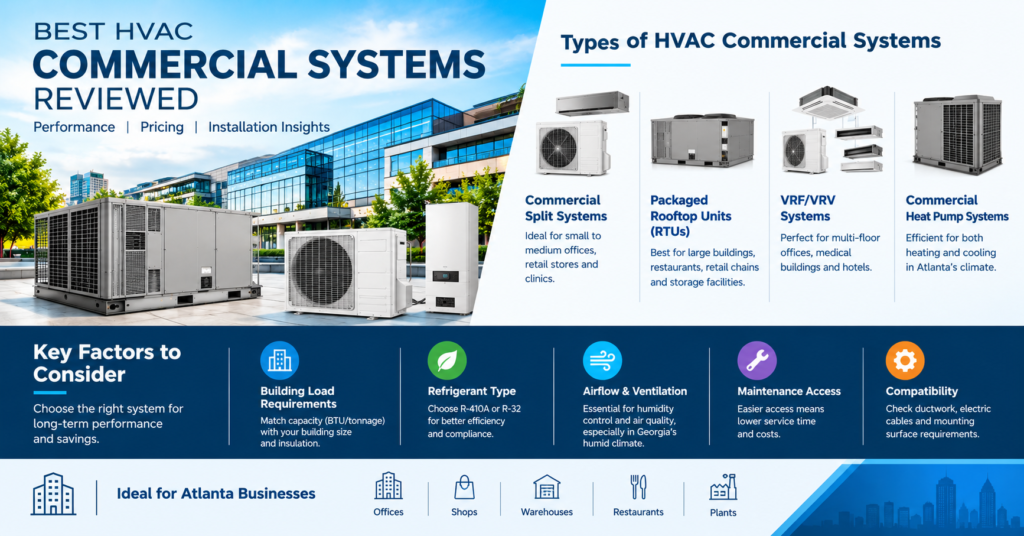
Commercial HVAC Split Systems
These systems have an indoor unit and an outdoor unit, and they are commonly used in small to medium-sized office areas, retail stores, and clinics.
Packaged Rooftop Units (RTUs)
Components are packaged together and are in one cabinet, which is placed on the roof, and they are used, more than anything else, in commercial buildings in Atlanta.
VRF/VRV Systems
These systems are appropriate for buildings that require zone control for air conditioning, such as offices over several floors, medical buildings, or hotels.
Commercial Heat Pump Systems
Heat pumps become efficient for both heating and cooling applications in climates like Atlanta’s.
These units are suitable for various buildings, depending on tonnage, configuration, layout, airflow requirements, and site constraints.
Factors to Consider Before Choosing the Best Commercial HVAC Units.
Building Load Requirements
The HVAC system capacity (BTU/tonnage) must be in proportion to the building size and insulation levels.
Efficiency Ratings
Higher SEER2, EER, and AFUE rates are generally more favorable, as they reduce operating expenses in the long run.
Refrigerant Type
Choose modern units that operate on R-410A or R-32 as they are more efficient and comply better with the regulations.
Airflow & Ventilation Quality
In commercial premises located in humid zones like Georgia, adequate filtration and humidity control are essential.
Maintenance Accessibility
Systems with easier access points will likely have lower service time and recurrent maintenance costs.
Compatibility with Existing Setup
Disruptions may be required for the ductwork, electric cables, and mounting surfaces before the new installation.
Based on durability, airflow, and overall performance, the following are some of the most common systems among Atlanta businesses.
Commercial HVAC Cost Estimates for Atlanta
Top HVAC Commercial Systems Reviewed: Performance & Reliability.
Commercial HVAC Split Systems
- Optimal for: Offices, clinics, retail establishments
- Reasons for functionality:
- Easy to install
- Heating/cooling control by zone
- Effective for multiple room configurations
Performance:
There is even airflow and differentiated temperature control within sectors of the building. During the hottest parts of the summer in Atlanta, Office Split Systems keep users comfortable.
Packaged Rooftop Units (RTUs)
Optimal for: Big buildings, restaurants, retail chains, storage facilities
- Reasons for common use:
- Indoor space is preserved
- Ice to the ceiling access for service
- Significant airflow potential
- Built to withstand the elements
Performance:
RTUs provide consistent airflow and effective temperature control, even under strained conditions. Noise pollution from airflow is mitigated by placing the RTU on the rooftop.
VRF/VRV Systems
Optimal for: Hospitals, hotels
Reasons for performance delta:
- Zoning features
- Temperature change over velocity
- Variable speed compressors
VRF/VRV systems lower the energy consumed by changing the speed of the compressor in response to the real-time demand.
Commercial Heat Pump Systems
Optimal for: Mixed-use properties, moderate climate conditions.
Why they work well:
Heat pumps work well for the Atlanta climate because they can provide heating and cooling. They can keep the occupants comfortable year-round temperature and operate efficiently.
Commercial HVAC Cost Estimates for Atlanta
HVAC has determined installation cost conclusions based on the type and installation of the system and its complexity, Atlanta HVAC market conditions, system tonnage, and installation complexity. The total cost and installation of your HVAC system are estimated below, with the understanding that the final cost could vary depending on the evaluated variables of your system type and the market for HVAC Atlanta.
HVAC Commercial Unit Price Ranges
- Smaller split systems (3–5 tons): Average $3.5–8
- Roof Packaged Units (RTUs): Average $5.5–14
- VRF/VRV systems: Average $12–45
- Large heat pump systems: Average $10–25
(Ranges are not fixed pricing, are market-based based and may vary depending on system size and features for all HVAC Atlanta market pricing.)
HVAC Commercial Installation Costs Atlanta
Typically, installations cost between $2.5-$18, depending on various factors, including
- Rooftop equipment
- Electrical requirements
- Duct changes
- The need for a crane
- The refrigerant lines
- The building’s height and structure, and/or building connections.
Multi-story buildings may have additional installation steps, resulting in a higher total cost.
Step-by-Step HVAC Commercial Installation
1. Building Assessment
Technicians help the building determine load requirements. They examine all building layouts.
2. Determine System
Based on requirements, determine the need for capacity, airflow, and zoning.
3. Infrastructure Preparation
May include duct changes, a mounting base, or electrical changes.
4. Installing the HVAC Commercial Unit
This step varies system to system: RTUs may require a crane, split systems may require grounded duct placement, or indoor/outdoor installation.
5. Electrical & Refrigerant Lines
Technicians complete the installation of the wiring, controls, and connected lines to the refrigerant system.
6. System Testing and Commissioning
Testing involves evaluating airflow, temperature, pressure, and thermostat functionalities.
7. While inspecting the system
It measures the overall performance of the system and confirms the correct distribution of airflow.
Tips for Maintenance for Longer System Life
- Change filters every 30-90 days
- Clean the indoor and outdoor coils
- Contemplate the level of refrigerant
- Clear obstructed drain lines
- Inspect ducts for airflow obstructions
- Set up yearly assessments
Routine maintenance increases overall system efficiency and minimizes potential downtime.
Issues Encountered in HVAC Commercial Systems
- Issues noted often include the following:
- Inequitable distribution of heating or cooling
- Excessive energy consumption
- Ducts with poor airflow or leakage
- Excessive noise
- Frequent cycling of the system
- Discrepancies in temperature sensing
- Moisture problems or improper drainage
Most issues can be alleviated with proactive maintenance.
Comparison: Best HVAC Commercial Systems by Use Case
| Business Type | Recommended System | Key Benefit |
| Small Offices | Split System | Efficient and practical |
| Restaurants | RTU | High airflow saves indoor space |
| Multi-floor Offices | VRF/VRV | Precision temperature zoning |
| Warehouses | RTU or Heat Pump | Strong airflow and durability |
| Retail Stores | Split or RTU | Consistent indoor comfort |
| Medical Buildings | VRF/VRV | Reliable temperature control |
Expert Note: Choosing the Right System for Atlanta
Based on building size and performance needs:
- VRF/VRV for energy efficiency
- Packaged RTUs for large open spaces
- Split systems for low maintenance
- VRF/VRV for multi-zone setups
- Split or packaged units for cost-conscious upgrades
Packaged rooftop units are still some of the most commonly used for commercial construction throughout Atlanta, given their capabilities and space-efficient design.
Frequently Asked Questions
1. What is the best HVAC option for large buildings in Atlanta?
For large buildings in Atlanta, we recommend packaged rooftop units or VRF systems for large-scale airflow and zonal control.
2. What is the usual lifespan of commercial HVAC systems?
With scheduled maintenance, commercial HVAC systems generally last between 15 to 25 years.
3. What impacts installation cost the most?
Building height, duct modifications, crane usage, electrical upgrades, and length of refrigerant line are the most impactful on the installation cost.
4. Are commercial split systems efficient for small businesses?
Yes, they perform well for smaller units with discrete sections.
5. How do I determine the right tonnage?
A load calculation executed by an HVAC technician is necessary.
Conclusion
While choosing the commercial heat pump system, you should think about the building’s capacity needs, airflow needs, expected overall efficiency, and price range of the system. The key goal for a business in Atlanta, whether they choose a split system, a packaged rooftop unit, a VRF arrangement, or a heat pump configuration, is to keep their customers and employees comfortable and their performance balanced all year long. These systems can keep working well for as long as they are supposed to if they are installed and maintained correctly.